
Chapter 3
I saw it.
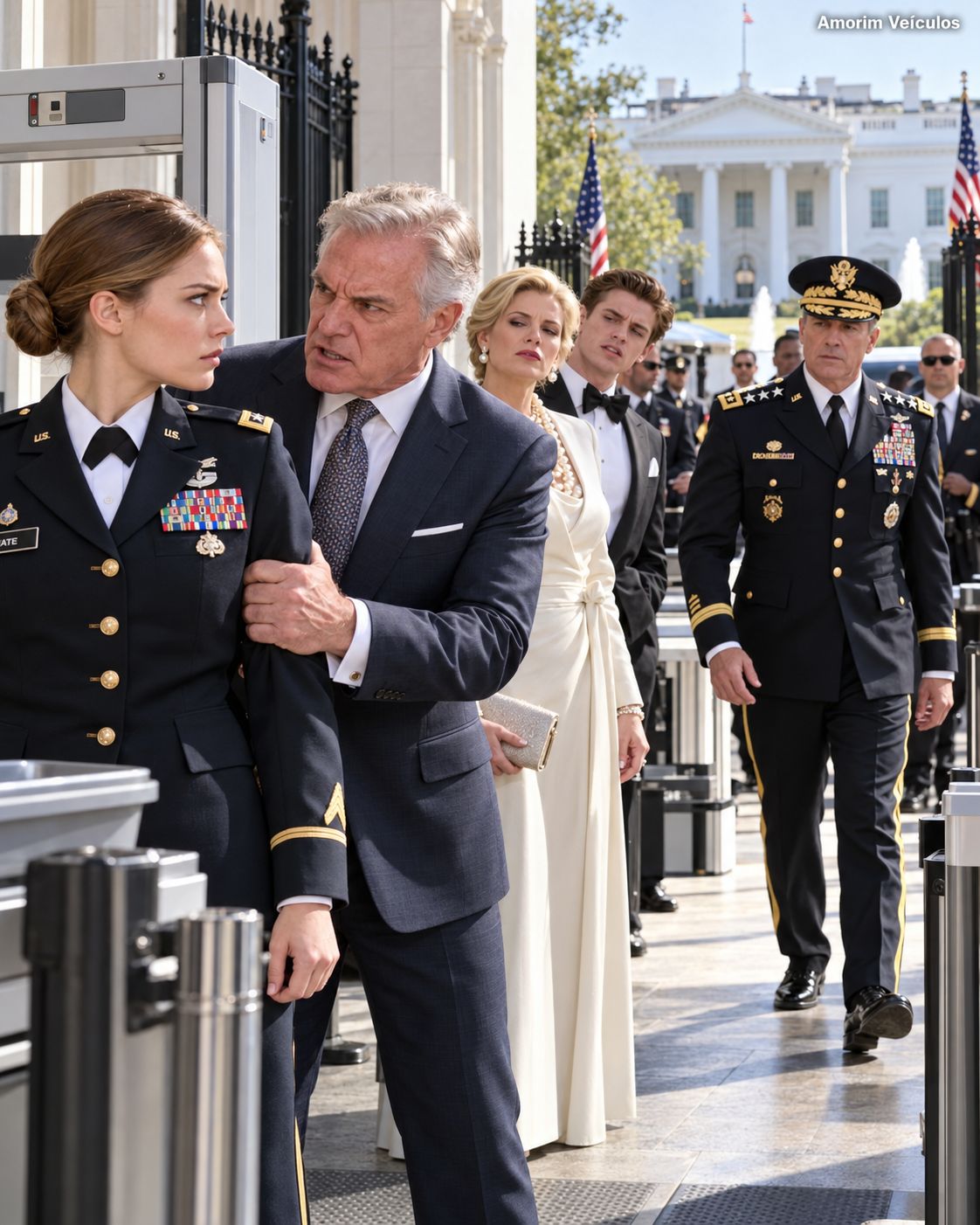
General Vance watched silently.
So did the Secret Service agents.
So did perhaps twenty wealthy donors who had stopped pretending not to listen.
Arthur lowered his voice.
"Katherine, we're family."
I actually laughed.
Not loudly.
Just once.
A short breath of disbelief.
"That's interesting."
His jaw tightened.
"We should not discuss private family matters here."
"You started discussing them here."
Arthur glanced around.
There it was.
The thing he'd always feared more than anything else.
Embarrassment.
Not guilt.
Not regret.
Embarrassment.
"Please," he said through clenched teeth.
I looked at the invitation lying near his shoes.
"You paid fifty thousand dollars to get into the building, Arthur. You might want to pick up your ticket."
Then I turned away.
General Vance walked beside me.
We were almost through the doors when he leaned closer.
"Father?"
"Biologically."
Vance sighed.
"I have four daughters."
"I know."
"If I ever spoke to one of them the way he just spoke to you, my wife would bury me under the rose garden."
Despite myself, I smiled.
"Your wife is terrifying."
"Correct."
The great doors closed behind us.
And for the first time in twenty-six years, Arthur Mercer was left standing on the outside while I walked into the White House.
The Roosevelt Room was already filled.
The Chairman of the Joint Chiefs sat near the center of the long polished table.
Beside him were the Secretary of Defense, the National Security Advisor, senior officials from intelligence, cyber operations, acquisition, and strategic planning.
A red folder rested at every seat.
My name was printed across the one directly opposite the Chairman.
GENERAL KATHERINE A. MERCERCOMMANDING GENERALSTRATEGIC SYSTEMS COMMAND
To Arthur, the military had always meant mud, tents, shouting drill sergeants, and people obeying orders because they weren't talented enough to do anything else.
He had never understood what modern warfare actually looked like.
Satellites.
Artificial intelligence.
Hypersonic defense.
Cybersecurity.
Autonomous systems.
Electronic warfare.
Strategic logistics.
And increasingly, the battlefield existed inside server racks long before anyone fired a weapon.
For the previous four years, I had commanded one of the organizations responsible for evaluating how emerging defense technologies would actually perform in operational environments.
That meant billions of dollars.
Hundreds of contractors.
Thousands of systems.
And plenty of companies desperate to convince Washington that their prototype was the answer to the next war.
One of those companies was Mercer Defense Technologies.
I hadn't touched their evaluation.