
Chapter 12
“People can do good things and still lie.”
She was quiet for a long time.
“I don’t want to lose another person.”
The sentence was so soft that I almost missed it.
My father had been gone twelve years. Mom had spent much of that time learning how to live around the empty spaces he left behind. Martin had filled some of them quickly. Perhaps too quickly.
I reached across the table and took her hand.
“You’re not losing me.”
Her fingers closed around mine.
“I should have told you he was making me uncomfortable.”
“You told me enough.”
“No, I didn’t. I minimized it.”
“Why?”
“Because every time I tried to explain, I heard myself defending him. I thought that meant I loved him.”
“It may only mean you were trying to make sense of him.”
She looked at me with tired, grateful eyes.
The back door opened.
We both turned.
Martin stood outside on the step.
He had left his jacket in the yard. Damp leaves clung to one sleeve, and his face looked older than it had at dinner. Not frightened now. Resigned.
Jonah appeared behind him.
“Martin came through the side gate,” Jonah said. “He asked to speak with Linda.”
Mom stood.
Martin’s gaze moved to the documents on the table.
He saw the original DD-214.
His shoulders dropped.
“You opened it,” he said.
“It was already open,” I replied.
“No. I mean you read it.”
Mom stepped between us—not to shield either of us, but to place herself in the conversation.
“Is it true?”
Martin looked at her.
“Which part?”
“That you served three years.”
“Yes.”
“That you were never a command sergeant major.”
His eyes closed briefly.
“Yes.”
Mom absorbed the answer without moving.
“And the document you showed the veterans’ center?”
“I altered it.”
Jonah remained silent.
Martin entered the kitchen but did not come farther than the threshold.
“I wasn’t trying to steal anything,” he said.
“You presented a false record to seek benefits,” Jonah replied.
“I wasn’t asking for money.”
“What were you asking for?”
Martin looked at me.
“A place.”
The answer was so unexpected that no one spoke.
He continued.
“I wanted to join the post. I wanted people to look at me and see someone who belonged there.”
“You served,” I said. “You belonged as yourself.”
“That’s easy for you to say.”
“No. It isn’t.”
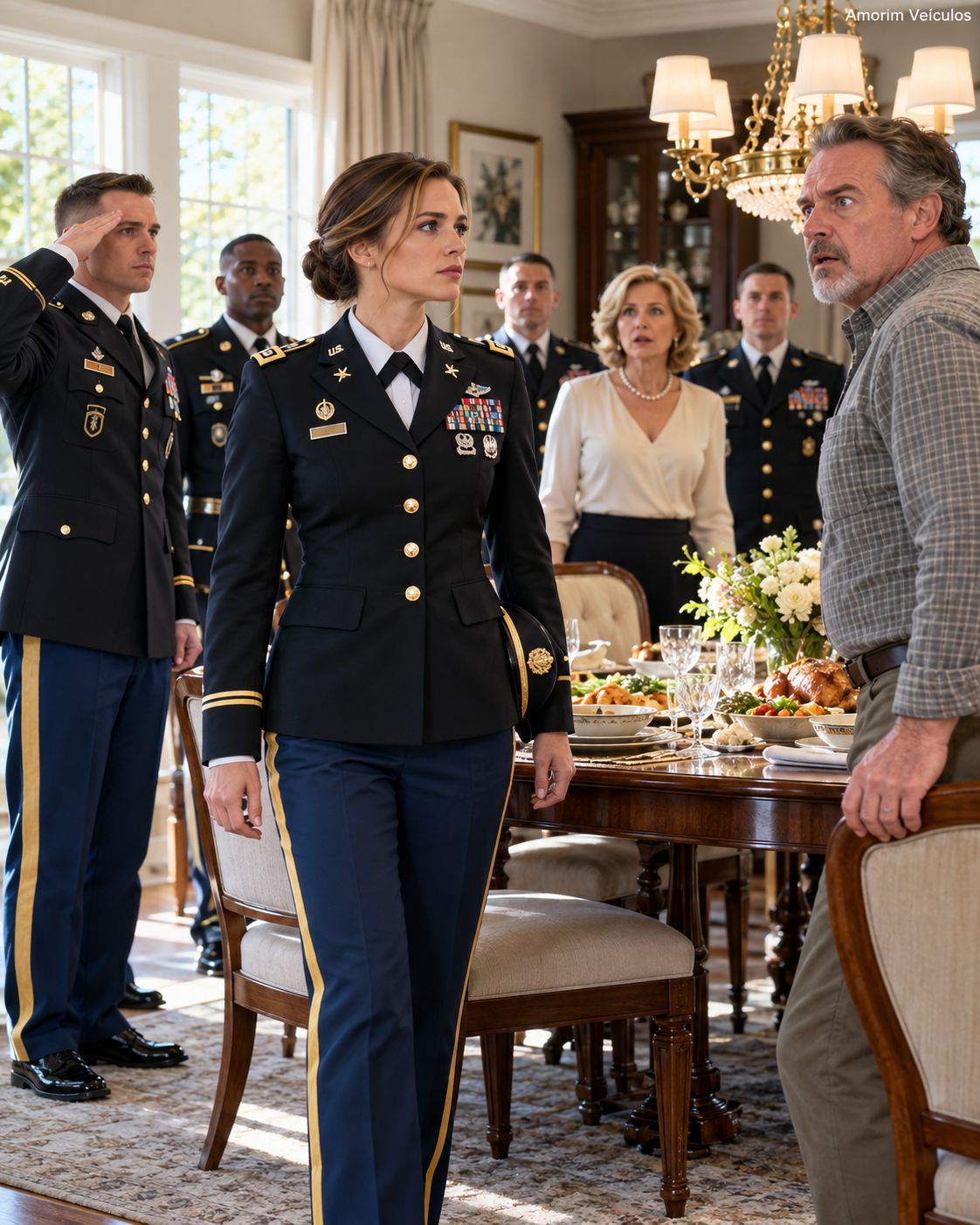
His eyes flicked to my uniform jacket hanging over the chair in the dining room.