
Chapter 2
I came because my mother needed a chance at life, and miracles in the American healthcare system didn’t accept payment plans or IOUs.
Six weeks earlier, Mama had dropped a heavy ceramic dinner plate beside the kitchen sink, her fingers suddenly refusing to grip the porcelain.
Before midnight, rushed to the county hospital under fluorescent lights that buzzed like angry hornets, doctors discovered a malignant, aggressive mass choking her pancreas.
The oncology specialists at Emory offered a cutting-edge immunotherapy treatment protocol that promised the absolute best chance of remission, but it came with a staggering, astronomical price tag that our insurance carrier coldly classified as experimental and refused to completely cover.
Two hundred sixty-eight thousand and four hundred dollars.
That was the barrier standing between my mother’s breath and her final sunset.
At that moment, I had fourteen thousand seven hundred dollars in a battered credit union savings account, an aging Ford F-150 with three hundred thousand miles on the odometer and a slipping transmission, a modest monthly Army pension that barely covered groceries and property taxes, and a part-time position clerking at the local hardware store where the register drawers smelled like copper and WD-40.
Cancer did not offer hardship discounts, and banks did not care about twenty years of honorable service when the mortgage or the medical bills came due.
So I searched every registry, every underground bulletin, and every obscure competitive circuit until I found the only single opportunity that could bridge that terrifying financial chasm: an elite, high-stakes private shooting championship hosted in Coronado, California, featuring an unprecedented three-hundred-thousand-dollar grand prize funded by defense contractors looking for marketing fodder.
Crawford had looked at me during check-in and seen a woman without corporate sponsor logos stitched across her chest, without a custom-tailored team jacket, and without any public civilian competition record on PractiScore.
He saw my faded ballcap, my frayed denim jacket, and my silence, and he decided I would be easy to brush aside for the cameras.
He was devastatingly wrong.
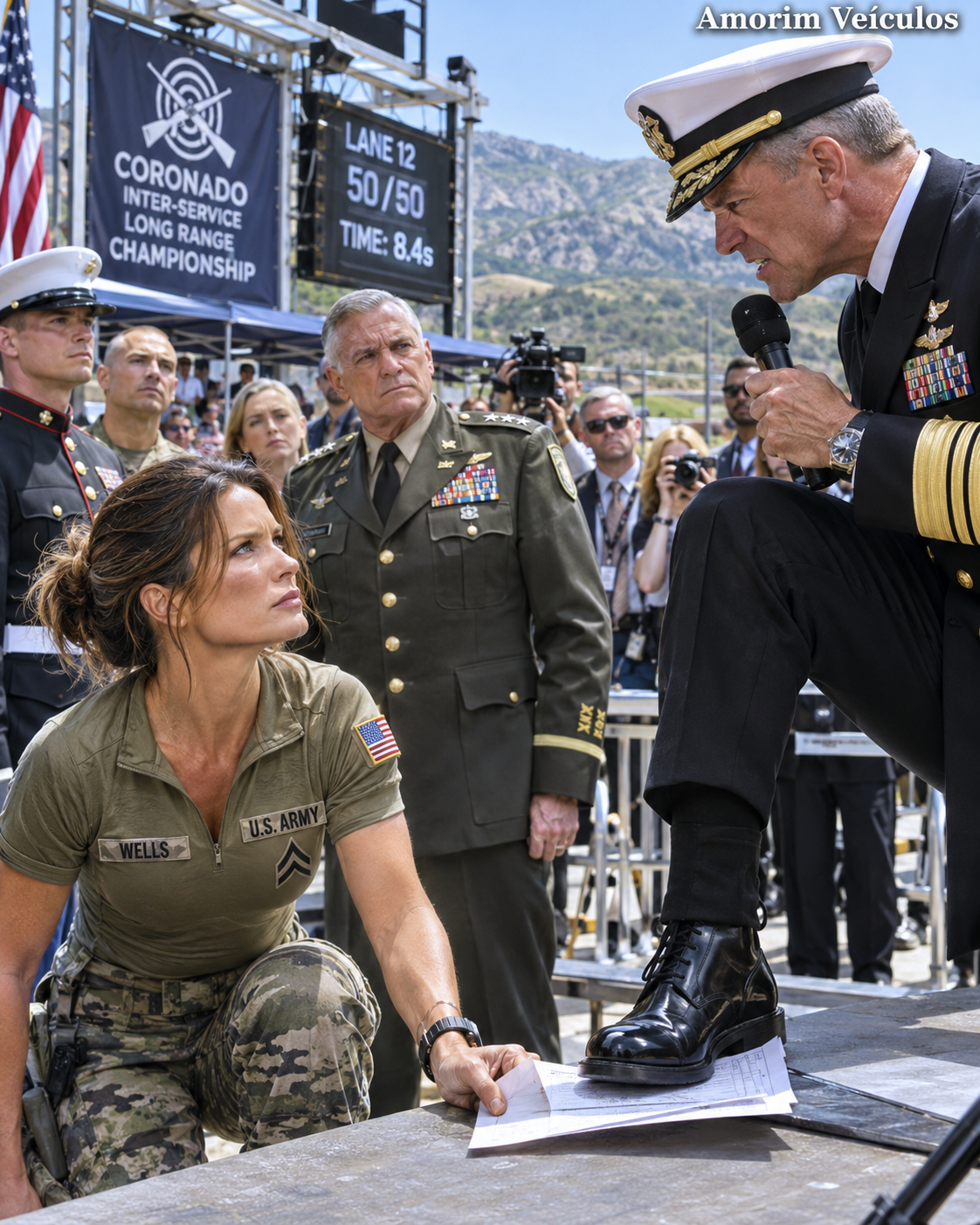
At 0800 hours sharp, fifty-seven competitors lowered themselves into prone shooting positions along the sun-bleached firing line.
High-end, custom-built modular sniper rifles costing upwards of fifteen thousand dollars each covered the range, resting on carbon-fiber tripods and fitted with ballistic computers.
Professional coaches paced behind their shooters, monitoring wind drift, humidity, and barometric pressure on specialized tablets.
I walked up to Lane Twelve carrying a twenty-year-old, battered aluminum rifle case with silver duct tape wrapped securely around one of its dented corners, holding a custom-action Remington 700 receiver that I had bedded and trued myself in a drafty Georgia garage using hand tools and sheer muscle memory.