
Chapter 8
Something about that answer changed the room. Colonel Kane gave the smallest nod, then closed the subject and started the interview.
For the next forty minutes, nobody asked about my family.
They gave me scenarios involving incomplete information, competing priorities, ambiguous sources, and decisions where every available option carried risk. I answered the way I had trained myself to answer over years of work: separate what I knew from what I assumed, identify the missing information, explain the consequence of being wrong, and never pretend certainty because uncertainty made other people uncomfortable.
Slowly, the kitchen disappeared from my mind.
I stopped thinking about Brianna’s face, Mom’s voice, Dad’s message, and the cold kitchen floor beneath my shoes. I became the version of myself my family almost never saw—the one who had spent years learning how to stay calm when information arrived fast, how to listen without waiting for my turn to speak, and how to say “I don’t know yet” without treating those words like weakness.
Then the door opened.
A major stepped inside first, followed by a two-star general I recognized immediately from professional briefings and internal communications. Major General Malcolm Vance had a reputation for being precise to the point of discomfort, the kind of senior leader who could sit silently through twenty minutes of discussion and then ask the one question everyone else had unconsciously avoided.
We stood.
“At ease,” he said, taking the open chair at the far end of the table.
His arrival was expected during the final portion, but knowing that did nothing to reduce the pressure in the room. General Vance opened my personnel file, read several pages without expression, and listened while Colonel Kane continued the interview.
Then his eyes lifted.
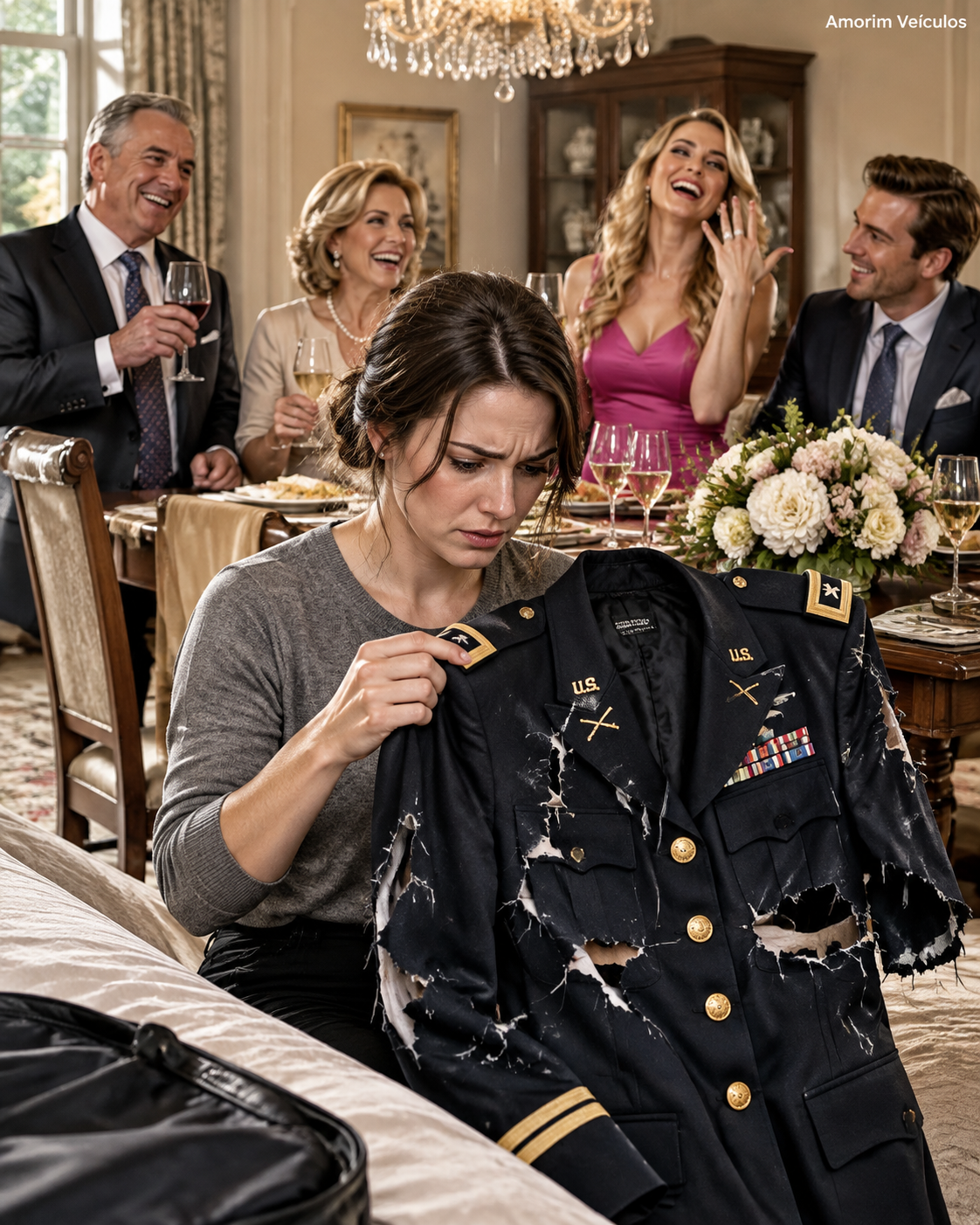
He looked directly at the damaged shoulder of my jacket.
His gaze dropped to the empty space where part of my ribbon arrangement should have been, then moved back to my face. I watched his expression change—not dramatically, but enough that Colonel Kane noticed too.
“Captain Cole,” he said, “is there a reason your uniform is damaged?”
“Yes, sir.”
“Explain.”
I repeated the facts. I told him I had inspected the uniform before bed, found it deliberately cut at five the next morning, had no reasonable opportunity to obtain a replacement, and chose to appear rather than request a delay.
“Who damaged it?”
“I believe it was my sister, sir.”
“Believe?”