
Chapter 9
“I did not see her cut it. I saw behavioral indications afterward and found household scissors near the uniform, but I won’t state an accusation as fact without direct evidence.”
The general went still.
Then he asked, “What happened to your ribbons?”
I removed the envelope from my portfolio.
For the first time that morning, my fingers trembled.
I placed the envelope on the table and slid it toward him.
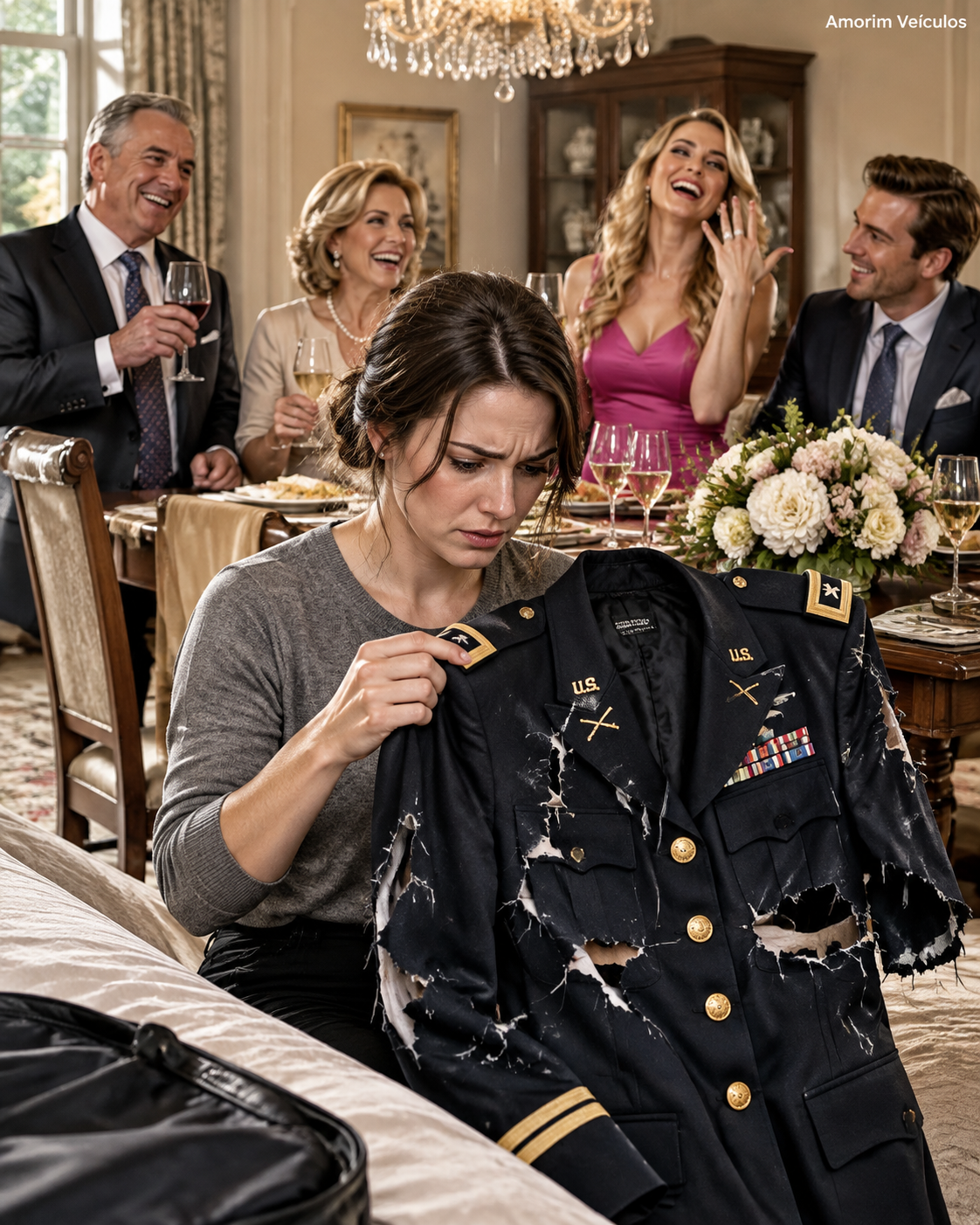
General Vance opened it carefully and arranged the damaged pieces in front of him one by one. I will never forget the silence in that room, or the way he looked at those small pieces of colored fabric and metal with more respect than my entire family had shown them at breakfast.
His face lost color.
“Captain,” he said slowly, “does your family understand what your work involves?”
“No, sir.”
“Have you attempted to explain it?”
“Within appropriate limits.”
“And?”
I almost gave the diplomatic answer. Habit told me to say they supported me in their own way, that civilian families could not always understand military careers, that it was complicated.
But something about standing there in a jacket held together by hidden safety pins made diplomacy feel dishonest.
“They consider it unimportant, sir.”
General Vance looked at my file again.
“I see.”
Those two words contained no pity, which was exactly why they mattered.
He turned to the rest of the panel and said, “For the record, Captain Cole’s appearance this morning should not be considered a failure to maintain standards. Under the circumstances described, her decision to report rather than conceal the situation or request special accommodation is relevant to the judgment criteria we are evaluating.”
My throat tightened, but I kept my face still.
Then he looked back at me. “Let’s continue.”
Nobody congratulated me. Nobody delivered a movie speech. The interview simply resumed, which somehow meant more.
For the final scenario, they gave me a hypothetical intelligence conflict where two sources contradicted each other and senior leadership wanted an immediate recommendation. I spent ten minutes walking them through what I would verify, what assumptions I would refuse to make, and what recommendation I could responsibly provide under time pressure.
When it ended, General Vance closed my file.
“Thank you, Captain.”
I stood, saluted, and left.
Only after the door closed behind me did I realize how hard my heart was beating.
I reached my car, removed the jacket before the damaged seam could worsen, and sat behind the wheel without starting the engine. I expected relief, humiliation, anger, maybe all three, but what I felt most strongly was exhaustion.