
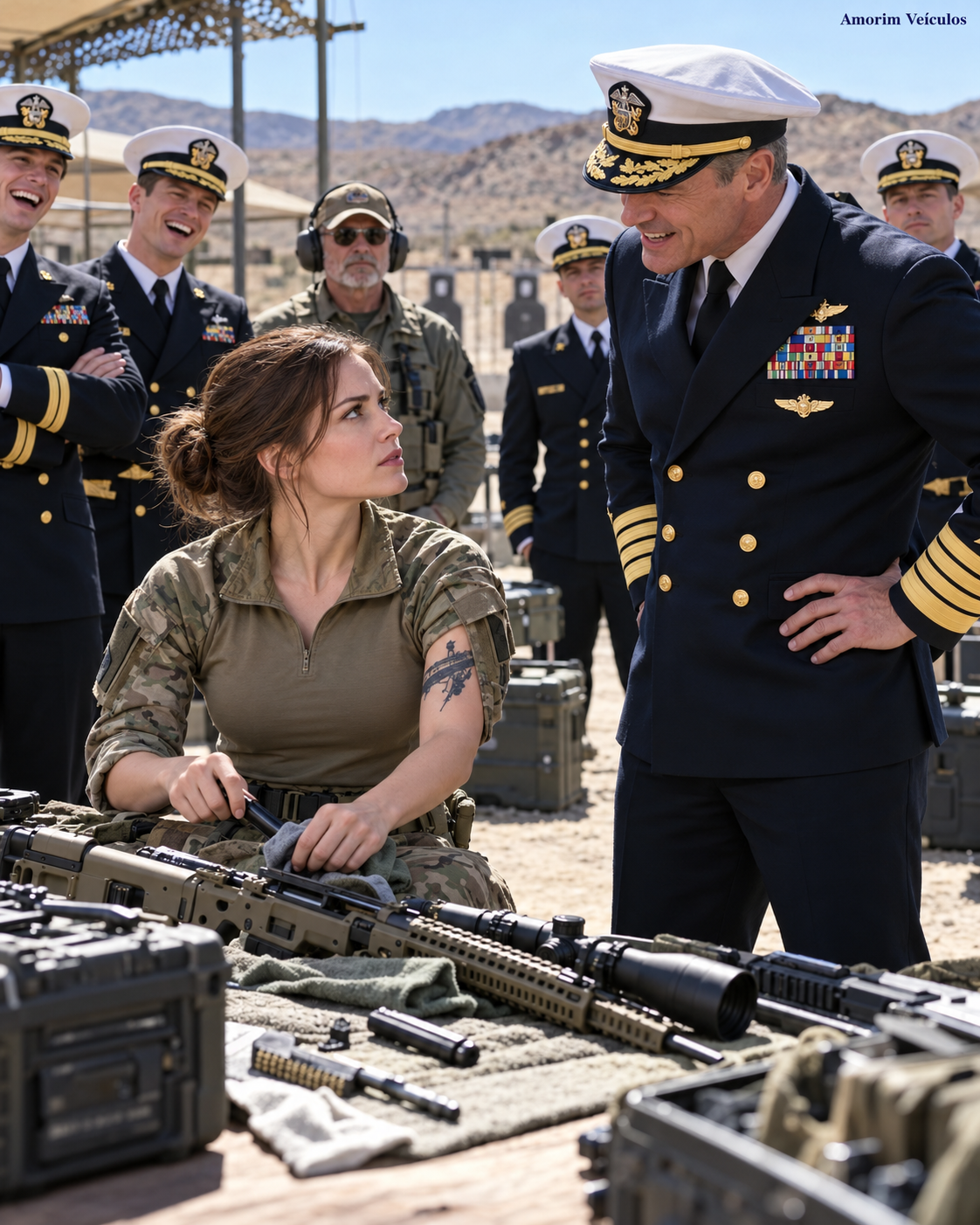
Chapter 5
“You could have introduced yourself,” he said.
“I could have.”
“Instead, you sat beside a shed dressed like a technician.”
“I wore the clothing I was instructed to wear.”
“By whom?”
“By the people who wanted an honest observation.”
His eyes narrowed.
“And what did you observe?”
“That you have a disciplined range when you’re watching it.”
The officers shifted uneasily.
Kane’s gaze hardened again.
“Careful.”
“I am.”
Ellis stepped in before the moment could become something else.
“Admiral, the afternoon course is ready.”
Kane remained silent.
The range assistant looked between them, uncertain whether to leave.
Finally, Kane nodded toward me.
“You’ll run the course.”
“I’m not here to qualify.”
“You’re here to evaluate.
You can’t evaluate what you can’t do.”
“That isn’t true.”
“Then prove me wrong.”
I almost smiled.
There it was again—that need to turn everything into a contest.
It was not unusual among senior officers.
Some had spent so long being responsible for outcomes that they treated every question as a challenge to their authority.
But I had met men like Kane before.
The ones who mistook control for confidence.
“Very well,” I said.
Ellis looked at me.
“You sure?”
“Yes.”
The course consisted of three stages: unsupported prone, barricade position, and a timed transition between two distances.
It was designed to test more than accuracy.
It tested decision-making under pressure, the ability to adapt to changing conditions, and whether a shooter understood the difference between speed and haste.
I took my place at the first station.
Kane stood behind the firing line with his arms folded.
Brooks was assigned the lane beside mine.
That, I knew, was deliberate.
The first relay began.
Brooks moved quickly.
Too quickly.
His rifle struck the barricade as he shifted, and he had to reset his position.
He recovered well, but the lost seconds mattered.
I moved at the pace the course required.
Not slow.
Not hurried.
At eight hundred meters, I fired three rounds and waited for the spotter.
Two impacts touched the black.
The third cut its edge.
At six hundred, I adjusted for the wind.
At four hundred, I changed position.
When the final timer sounded, Ellis read the results.
“Three minutes, forty-two seconds.”
Brooks finished at three minutes, thirty-eight.
He looked pleased until Ellis added, “Morgan’s score is higher.”
Brooks glanced at the target board.
His grouping was faster but scattered.
Mine was slower by four seconds and nearly twice as consistent.