
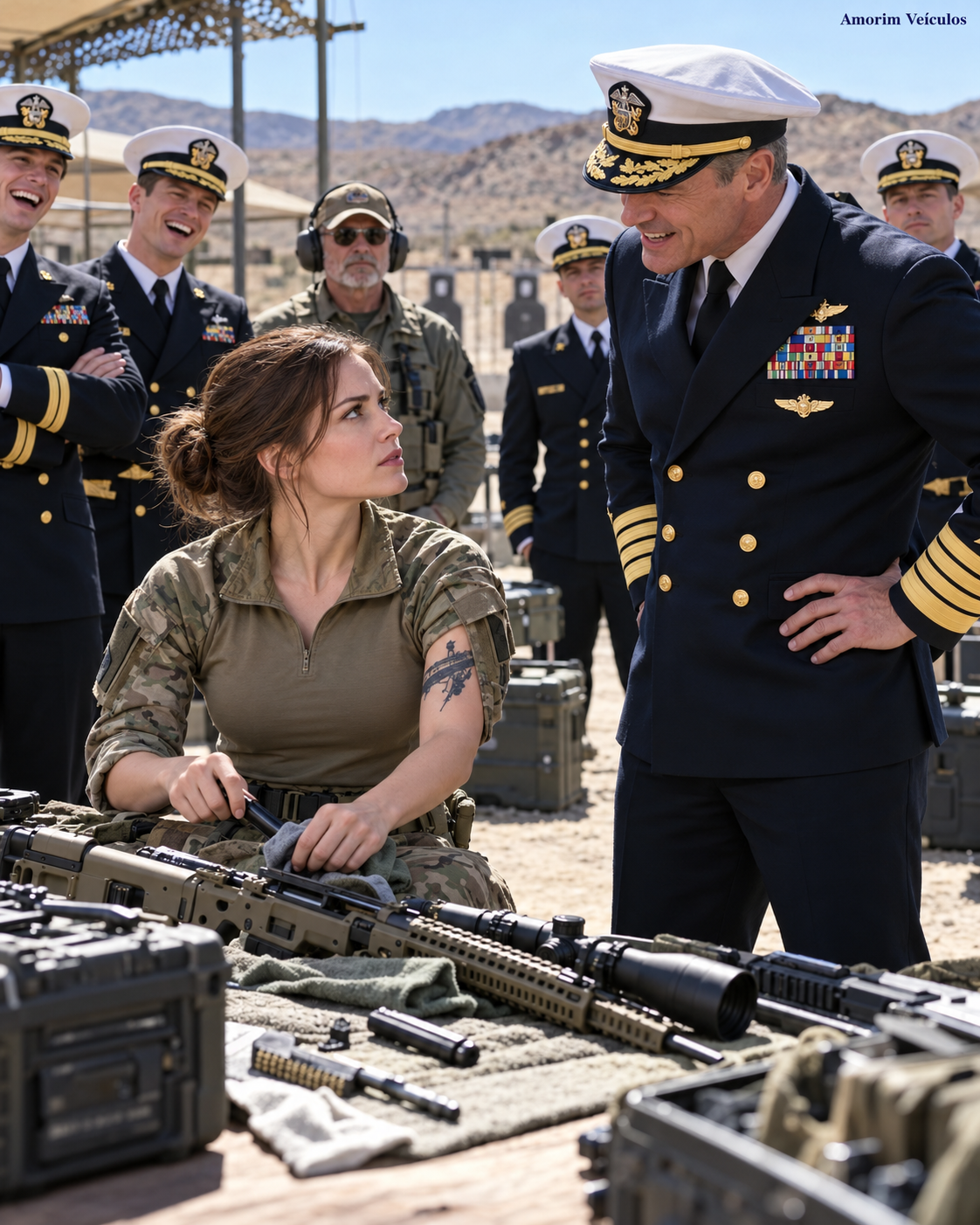
Chapter 4
“You asked an unidentified shooter to observe a Navy qualification exercise?”
“She was identified to the people who needed to know.”
“I’m the commanding officer of this exercise.”
“Yes, sir.”
“Then why wasn’t I informed?”
Ellis glanced toward the distant target berm.
“You were supposed to be.”
That answer landed harder than any accusation.
Kane’s shoulders squared.
“Supposed to be by whom?”
Before Ellis could reply, a range assistant hurried toward us carrying a sealed envelope.
“Master Chief,” he said.
“This came through the operations office.”
Ellis accepted it.
The envelope was thick, official, and stamped with a red stripe.
My name was printed across the front.
CLAIRE MORGAN.
Underneath it, in smaller letters:
INDEPENDENT EVALUATOR — LONG-RANGE TRAINING REVIEW.
Kane saw the label.
“So that’s who you are.”
I didn’t answer.
He held out his hand.
“Give me that.”
Ellis didn’t move.
“Master Chief,” Kane said.
“This is addressed to Ms.
Morgan.”
“I have a right to know what’s happening on my range.”
“You have a right to know that the review is taking place,” Ellis replied.
“The contents are restricted.”
“Restricted from me?”
“From everyone not listed on the distribution sheet.”
Kane looked at me again.
“You’re evaluating us?”
“I’m observing the course.”
“That’s not what the envelope says.”
“No, sir.”
His expression changed.
It wasn’t embarrassment.
Not yet.
It was calculation.
He looked at the six officers standing behind him and seemed to see them differently now—not as an audience, but as witnesses.
The thought irritated him.
“What exactly are you reviewing?” he asked.
“Safety procedures.
Instructional quality.
Range control.
Long-distance marksmanship standards.”
“And personnel conduct?”
“That depends on the scope of the review.”
“Does it include conduct?”
I held his gaze.
“It can.”
The officers grew very quiet.
I had not come to punish anyone.
I had not even expected to speak with Kane.
My assignment had been simple: observe the range, compare its training methods against the new joint-service standards, and submit a report.
The comments made at the equipment shed would have been forgettable if they had been isolated.
But they weren’t isolated.
During the previous hour, I had watched one lieutenant skip a chamber check, another disregard a cease-fire instruction, and Brooks correct a junior sailor in front of the line without ever checking whether his own rifle was safe.
The laughter had only made the pattern easier to see.
Kane knew it now.